What your child does — and what they get from it.
Five simple steps turn a question they care about into something they built themselves. No coding knowledge needed to follow along.
Start with a real question
Your child brings something they actually care about — “how do I warn fishermen when the sea gets rough?” Pip helps them make it clear and specific.
What they gainHow to ask well — the skill behind getting anything useful out of AI.
Make a plan, in their own words
Before any technology, they break the idea into simple steps — like writing a recipe. Pip nudges, but never writes the plan for them.
What they gainHow to turn one big problem into small, doable pieces — the heart of problem-solving.
Build it, piece by piece
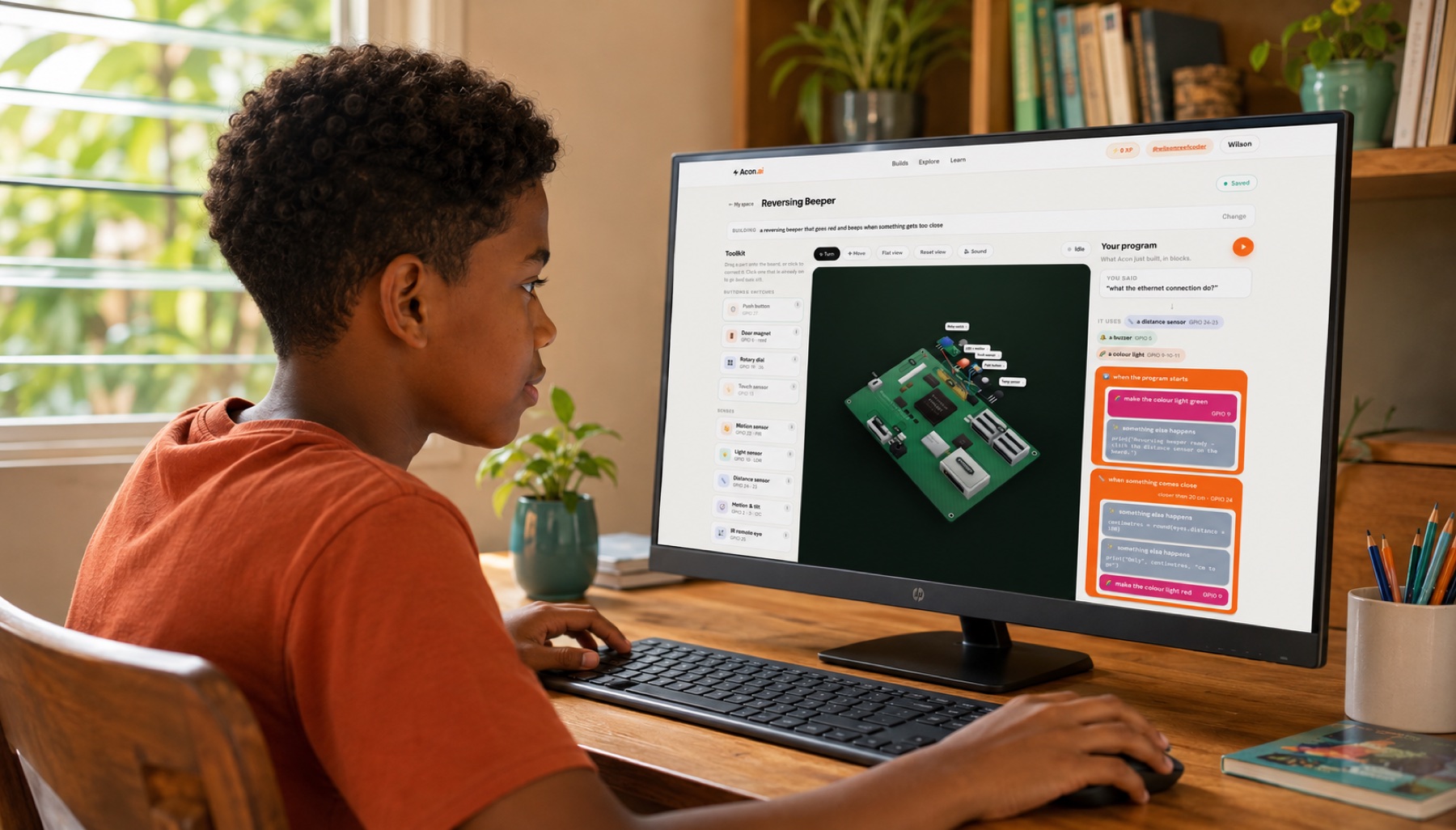
Each step becomes a coloured block they can see and move around. Change one, run it again, and watch what happens.
What they gainA real feel for how things work — cause and effect, not magic.
See the real code — if they want
Curious? Pip shows the very same thing written as real code. Many kids peek; none are pushed. Building it comes first, always.
What they gainA gentle on-ramp to real programming, entirely at their own pace.
Test it, and make it better
Pip asks them to try it against the real world and spot what is wrong. Getting it wrong is where the learning actually is.
What they gainTo question the machine instead of trusting it — the habit that matters most with AI.
The same five steps, on a board they can hear.
Some of what they make isn’t on a screen — it’s a real gadget. A Raspberry Pi computer sits on screen, so parts are dragged on rather than bought, nothing gets wired up wrong, and nothing can break. But it lights up, beeps and speaks for real.