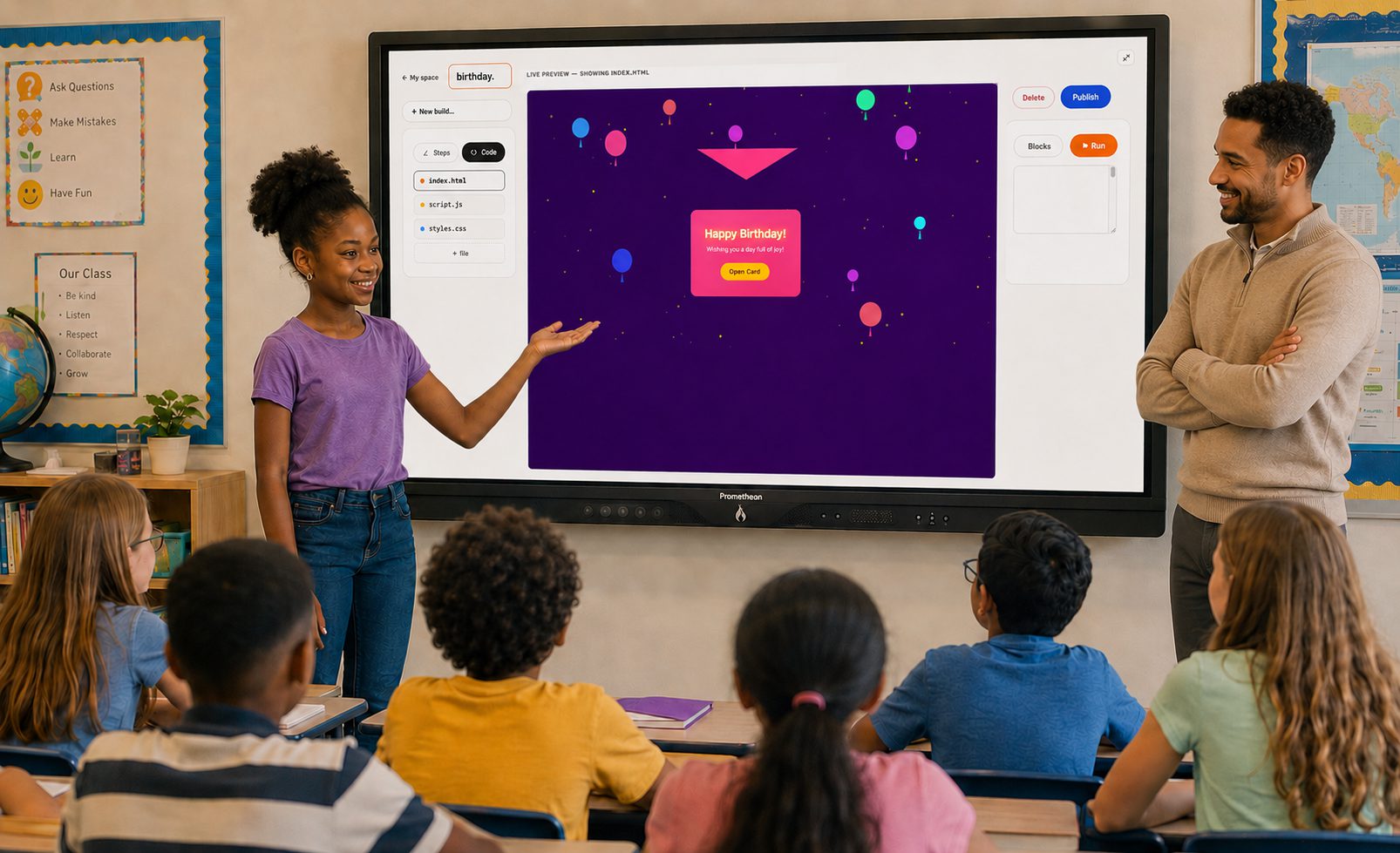
Teach the skill their parents keep reading about.
Every child in your club builds real things by directing AI — and learns why it works, which is the part that will still matter at twenty-five. You get the proof on one page.
Four things to build. A term of teaching in each one.
Every build is a lesson wearing something a child actually wants to make. They pick the thing; you teach what's inside it.
A paddle-and-ball, a shark quiz, a platformer that gets harder — live at an address their friends can play.
Loops, conditions, coordinates, keeping score — and what “make it harder” really means: changing one variable and testing again.
A site about their team, their dog, their island — a real address, not a file on a laptop.
Structure, content, and audience — what goes on a page, in what order, and who it's for. The oldest lesson in publishing, on the newest tools.
A record of every apple sale — who bought, how many kilos, what they paid — kept in a database that still has it next week, and adds it up for them.
A door chime, a heat alarm, a stopwatch that takes a photo — on a virtual Raspberry Pi with 23 parts, so nothing gets bought, wired wrong, or broken.
Inputs, sensors and thresholds — how software meets the physical world. When is the water too hot? That's a number someone has to choose, and this week it's them.
And underneath all four, the same skill: they say what they want, plan it, and direct the AI to build it — then take it apart to see why it works. That's the part their parents keep reading about.
A challenge is a brief, not a worksheet.
It says what the thing must do — never how. You set one, add a due date if you want it, and it lands pinned at the top of every student's challenges page. When they hand in, the marking happens without you.
One button
“Make a game you play with one key and nothing else. Everything else is up to you.”
Have we got one?
“Make a list of what is in the kitchen cupboard that you can check from the shop — so nobody buys a fourth bottle of ketchup.”
Changed my mind
“Make a gadget that counts down before it does its thing — so there is still time to press cancel.”
Thirty in the library today — games, websites, gadgets and open briefs, graded easy to tricky, every one marked against the student's own code.
The parents are on your side.
Essays come back as an offer to build something instead.
The marking must quote the child's own code before it says yes.
No chat, no strangers, no email addresses; their code can't even reach the internet.
This is the answer when a parent asks “so the AI does it for them?” — and it's yours to use.
One page runs the whole room.
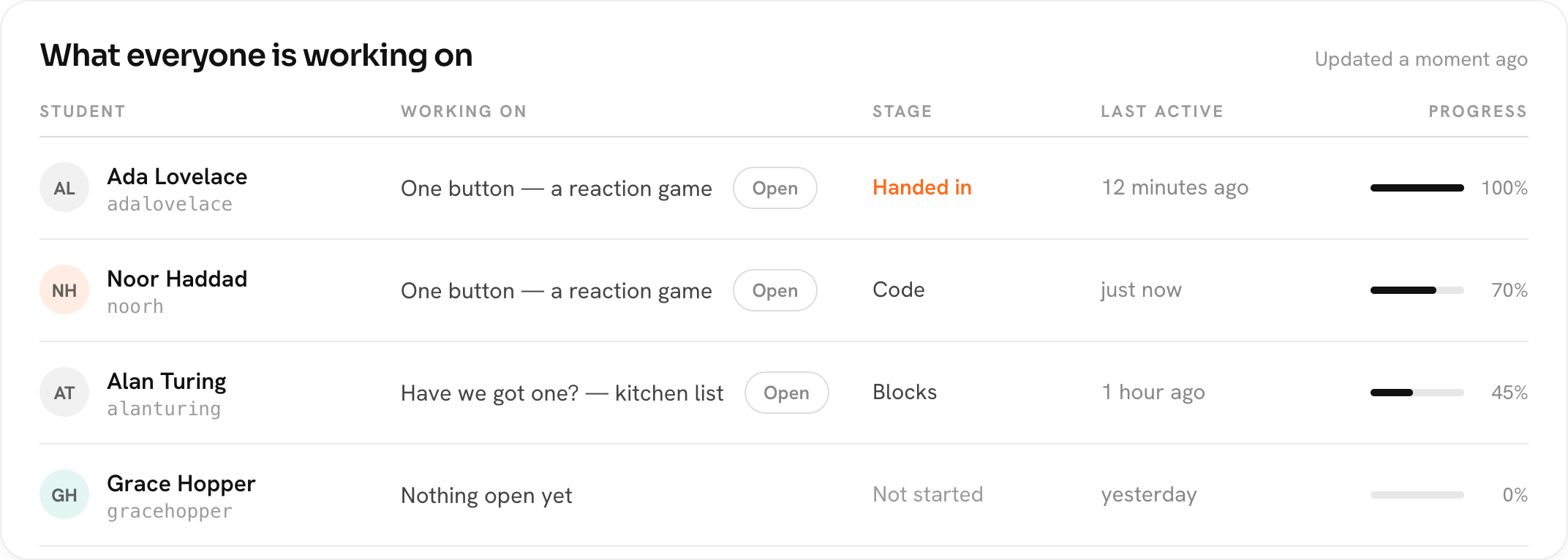
Every student, what they're building, its stage, its ticks. Who's stuck and who's coasting, at a glance.
Open any row and read exactly what the student was told, evidence included. You mark nothing.
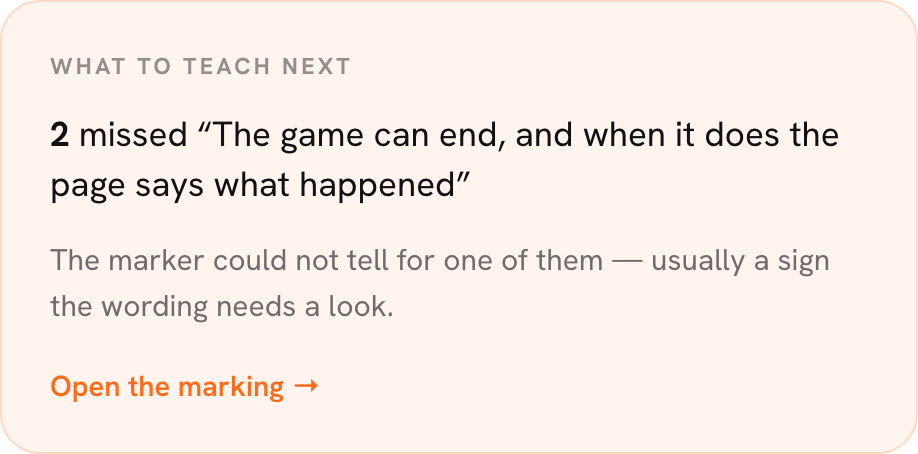
The criterion most of the class missed, counted from the marking.
Paste names, print logins once, reset passwords in one click. A class exists in five minutes.
Less than one child pays for one session.
Per month, for the whole club, unlimited classes. Free while the pilot runs; billing isn't connected and nobody has ever been charged. Nothing starts silently.